

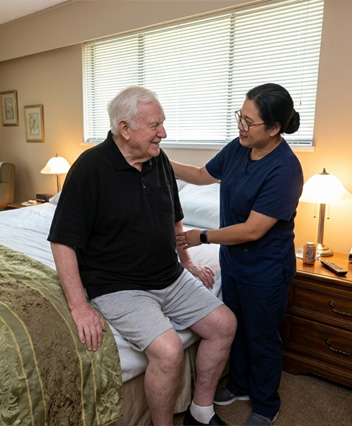
Not at all. Plenty of families arrange overnight care simply for fall prevention, post-surgical recovery, or peace of mind after a parent starts living alone.
Yes. Overnight visits can be scheduled as often or as rarely as your family needs, whether that's every night or just the nights a caregiver isn't otherwise available. Some families use these nights as respite care so the family caregiver can rest.
It depends on the schedule. Some families use one consistent overnight caregiver for every visit, while others rotate two or three so no one gets burnt out working nights repeatedly.
No. Overnight caregivers stay awake and alert throughout the visit, checking in periodically and responding right away to bathroom trips, restlessness, or anything unexpected.
No. Schedules can change week to week based on appointments, work commitments, or simply how your loved one is doing that particular week.
Personal hygiene, light meal prep, medication reminders, and companionship are common, though each visit is shaped around whatever your loved one actually needs that day.
Day and afternoon shifts have a 3-hour minimum per shift. Overnight shifts have an 8-hour minimum.
Definitely. Many families combine hourly visits with overnight or post-hospital care to cover different parts of the day without paying for full-time coverage they don't need.
Not necessarily. It's also common for advanced dementia, significant fall risk, or when a loved one needs support with personal care, toileting, mobility, comfort and safety throughout the day and night.
Plans are reviewed regularly, since a routine that works one month may need adjusting the next as a senior's condition or needs shift over time.
No. 24-hour in-home care is provided through coordinated caregiver shifts, ensuring continuous support throughout the day and night. We prioritize consistency by assigning a dedicated care team.
Overnight care covers the nighttime hours, with awake caregivers who assist with personal care, toileting, mobility, comfort and safety, while 24-hour care provides continuous support throughout the day and night through coordinated caregiver shifts. All arrangements are based on individual care needs and caregiver availability.
We ask about interests, temperament, and daily routine during the initial consultation, then match based on genuine compatibility rather than simple availability.
Coverage varies by individual circumstances and provincial programs. We recommend discussing your specific situation with our care coordinator during a free consultation.
It's more involved than that. Caregivers engage in conversation, shared activities, outings, and hobbies, tailored to whatever actually makes the visit meaningful for that person.
Yes. While the focus is social and emotional support, caregivers often help with light meal prep, tidying, or accompanying a senior to appointments and errands.
It varies by diagnosis and recovery speed, ranging from a few days to several weeks, with care plans adjusted as healing progresses.
Yes. Caregivers follow discharge instructions closely, including medication timing and dosage reminders, to help prevent complications during the early recovery period.
Ideally before. Reaching out while your loved one is still in the hospital lets us build a plan and have a caregiver ready the day they come home.
Caregivers are trained to recognize warning signs and know when to contact family members or healthcare providers immediately rather than waiting to see if it resolves.
No. Caregivers don't assess wounds or provide medical treatment. During visits they can notice visible changes, or signs that your loved one seems unwell, and report them right away to the family or the care team, following the instructions given by the hospital or doctor.
It's easier with advance notice, but we work to accommodate urgent situations whenever possible, especially when a family reaches out before the surgery date.
Both. Caregivers can assist with pre-op preparation, including fasting instructions and transportation to appointments, then continue supporting recovery once your loved one is home.
Joint replacements, cardiac procedures, and outpatient surgeries like cataract operations are common, though care plans are built around whatever procedure your loved one is having.
Yes, and we prioritize this specifically for memory care, since familiar faces and consistent routines genuinely help reduce anxiety and confusion.
Yes. Caregivers actively supervise for wandering risks and can be scheduled during the hours when confusion or sundowning tends to worsen.
Memory care caregivers receive specific training in dementia behaviors, including de-escalation, redirection, and communication techniques suited to someone with cognitive decline.
Caregivers are trained to stay calm and use gentle redirection rather than correction, which tends to prevent agitation from escalating further.
Often, yes. Caregivers can support prescribed exercise routines between physiotherapy sessions, though they don't replace a licensed physiotherapist's direct treatment.
Yes. Caregivers often identify and help address hazards like loose rugs, cluttered walkways, or poorly placed furniture during regular visits.
Arthritis, stroke recovery, Parkinson's disease, and general fall risk are among the most common reasons families arrange dedicated mobility support.
Yes. Caregivers receive specific training in body mechanics and safe transfer methods to reduce injury risk for both the client and the caregiver.
Need a break from caregiving? Learn about respite care for family caregivers. Not sure what a term means? See our glossary of care services.
United Respite Care is a locally owned agency providing private, non-medical in-home senior care and respite in Langley, Surrey and Delta, BC.

Copyright © United Respite Care Inc. 2026 | All Rights Reserved